Ganesha Ecosphere: Leading India’s Circular Textile Revolution with Innovation, Scale and Sustainability
As the global push for sustainability accelerates, recycled polyester has emerged as one of the most critical materials in the transition to circular manufacturing systems. Demand is rising rapidly as international brands, policymakers and consumers seek lower-impact alternatives to virgin plastics. At the centre of this shift stands Ganesha Ecosphere Ltd (GESL)-India’s pioneering and largest producer of recycled polyester staple fibre (rPET fibre), and one of the fastest-growing names in the global circular materials landscape.
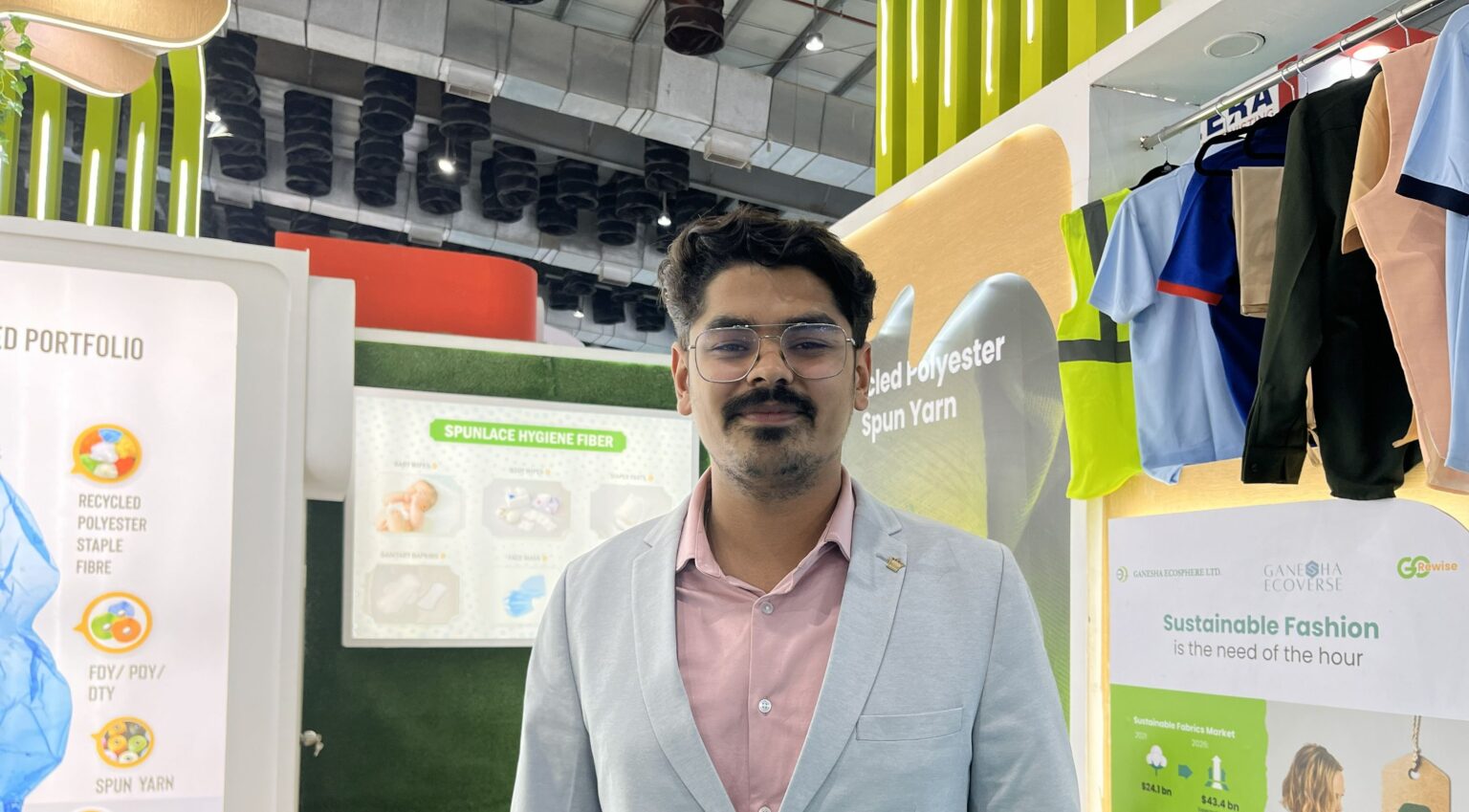
At Techtextil India 2025, Mr. Harsh Sharma, Vice President of GESL, shared insights into the company’s growth trajectory, its pioneering role in PET recycling, and its ambitions in specialty materials and textile-to-textile circularity. His perspective reflects a company not only scaling rapidly but also shaping the next chapter of sustainable textiles in India and beyond.
A Legacy of Leadership: From India’s First rPET Plant to a Global Powerhouse
Ganesha Ecosphere’s circular journey began in 1994, when it became the first Indian company to recycle post-consumer PET bottles into polyester staple fibre. From a modest 6,000-tonne annual capacity, GESL has transformed into one of the top rPET fibre manufacturers worldwide, with a total installed capacity of 196,440 tonnes per year as of FY 2024.
Today, its portfolio has expanded far beyond staple fibre. GESL now produces:
- rPET Yarns
- rPET Fibres
- rPET Granules
- rPET Filament Yarns
- Specialty Fibres & Yarns
- rPET Flakes
With 500+ product variants used by leading global names across fashion, packaging, furnishings, automotive, filtration and nonwoven sectors, Ganesha has become a benchmark for innovation, diversification and scale in recycled polyester.
Expanding Global Footprint Across 20+ Countries
Exports account for 20% of GESL’s sales, with products shipped to Europe, the United States, Turkey, Nepal, Spain, Germany, Portugal, Italy and the UK.
Europe’s tightening regulations on recycled content in textiles and packaging have created substantial opportunities. With upcoming mandates for extended garment lifespans and compulsory use of rPET, demand is expected to grow dramatically-an area where Ganesha is well positioned.
In India, regulatory momentum is also accelerating. A new directive requires packaging producers to incorporate a minimum of 30% recycled content from April 2025, further expanding the market for food-grade rPET chips.
End-to-End Traceability: Ganesha’s Strategic Advantage
As global brands increasingly prioritise transparency, GESL offers a capability few can match-complete end-to-end traceability, from waste collection to final materials.
The company controls the entire chain:
PET waste → sorting → washing → granulation → fibre → yarn → finished materials
This traceability strengthens brand trust and helps meet compliance requirements related to:
- Verified recycled content
- Carbon footprint reporting
- Responsible sourcing
It has become one of the most influential factors for global brands selecting long-term recycling partners.
The Next Frontier: Textile-to-Textile Recycling
While bottle-to-fibre recycling is firmly established, textile-to-textile recycling-considered the true pathway to circularity-remains technologically challenging, particularly for polyester blends.
Ganesha is actively exploring solutions in this field. Although large-scale recycling of polyester-cotton and poly-viscose blends is still under development worldwide, the company recognises its transformative potential. However, the company sees immense potential once technical barriers are solved Ganesha is preparing to invest in advanced technologies as they mature.
Future Outlook: Positioned for the Global Surge in rPET Demand
With leading global brands adopting ambitious recycled content targets for 2030, the demand for rPET is set for sustained, long-term growth. Polyester accounts for 50% of global fibre consumption, and recycled polyester is poised to dominate future value chains.